Nobody ever said, “I love you.” Nobody ever said, “You cried because your heart was heavy.” Whenever I was upset, they would say, “Stop acting spoiled. What do you lack? Look at other people’s children…” I learned to stay quiet. I learned to make myself small so that there would not be another argument. But strangely, the quieter I became, the more guilty I felt. As if, whenever something bad happened, I must have done something wrong. If Mom cried, I must have upset her. If Dad shouted, I must have gone too far.

Their words were like daggers—not the kind that pierce once and are over, but daggers that, every day, every hour, and every time they were spoken loudly or even through meaningful silence, took away another piece of my soul. They would say:

“A girl should be like so-and-so. Why are you like this?”

Or:

“Stop acting spoiled. You’re grown up now. Use your common sense.”

“You’ll never amount to anything. You’ve become too sensitive. Everyone has these circumstances; you’re the only one who always goes against the flow.”

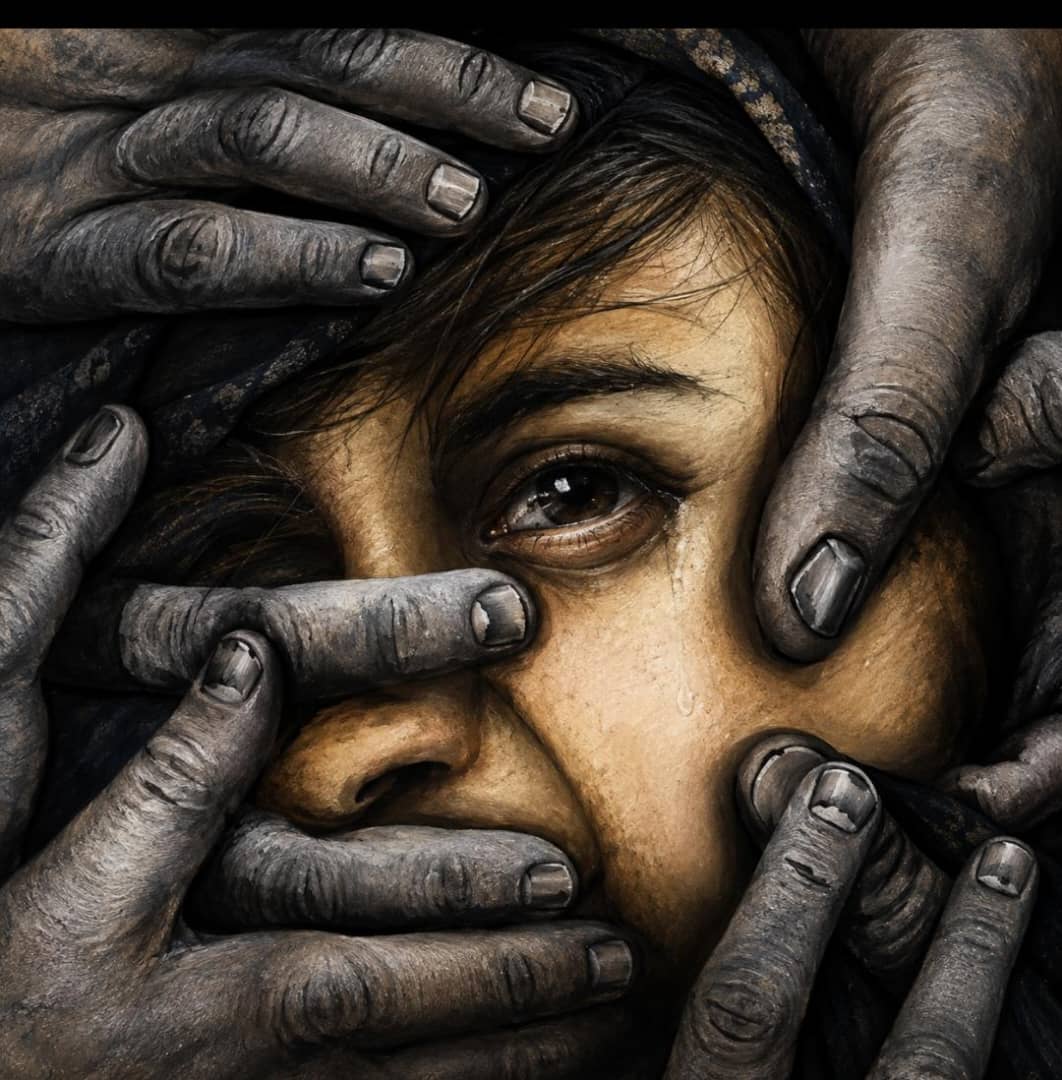
No one saw how those words scratched at her heart and mind. On the outside, everything looked normal: a family, a house, and a girl. But inside her, every word was like one brick placed upon another, building a wall between her and herself. She no longer believed in herself. Whenever she wanted to speak, a familiar voice echoed in her mind: “What do you know?” And right there, her mouth would close.

When a family gives cold and wounded words instead of love, a girl learns that words can be more dangerous than a slap. She learns to censor herself; that to survive, she must live quietly.

Sometimes their words hurt more than the people who spoke them—not because they were loud, but because they were precise, like an arrow hitting exactly where it hurts; a place within the girl that she had not yet built, a place she had not yet made safe. “If you cannot be the way we want you to be, then it is better that you say nothing. There are so many girls; why are you the only one who always has problems? Enough already. You exhaust everyone with these unnecessary emotions of yours.”

She became silent in public and fell apart in private. On paper, she breathed. Inside her, she wrote: “I wish, just once, someone would ask what really happened—not to judge me, not to compare me, but simply to listen.” But no one asked. And so the girl consumed herself until there was almost nothing left, except a silent image of a girl who could have been so many things if only someone had listened to her a little.

My adolescence began with the awakening of pain—not the kind of pain felt in the knees or back, but the hidden pain in the heart, in the darkness of the mind, in eyes that slowly came to understand: the place that was supposed to be a refuge had become a source of hurt.

My first wounds were verbal; not shouting, not arguments, but that same cold, emotionless sentence: “You will never amount to anything.” It was repeated so many times that, little by little, I believed it myself. I grew distant from myself, from my dreams, from the voice inside me that still whispered of life. When I asked my mother for affection, her silence settled over my heart like an iron lock. When I asked my father for respect, his mocking laughter felt like a slap that quietly sank into my soul without anyone noticing. I learned to burn in silence. I learned not to speak of my pain, because when I did, they said, “It’s adolescence. You’re just being spoiled. You’ll grow up and forget it.” But I grew up, and I did not forget.

Sometimes I wondered, “Am I too much? Is my existence unnecessary?” Because I was either ignored or noticed only when I had done something wrong. There were no embraces, no praise; I simply had to be a good girl, without anyone ever explaining what being good actually meant.

A good girl? It meant be quiet. It meant do not ask questions. It meant do not feel anything. It meant smile when you wanted to cry. It meant never doing anything that might upset the family, even if that family upset you every day.

No one ever said I was at fault because I was a girl, but I understood it through their looks, through the silence after I cried, through my mother’s fearful words: “Don’t let your voice be heard. What will people say?” Among all those words, a lump in my throat felt like a burning weight. There was no choice; I had to remain silent. A silence no one understood was filled with screams inside me.

Sometimes, alone at night, in the darkness of my room, those suppressed screams would rise from every corner of my being. I wanted to say that I was tired… tired of being compared, tired of hearing, “He was a boy; it’s different,” tired of everything I did being either too much or never enough.

At school, I wore a mask. In public, I laughed, spoke loudly, and sometimes even joked, because no one was supposed to know that at night I could not sleep for hours, that I was afraid of myself, that I had been wounded more deeply by my family than by strangers.

And no one understood, because verbal wounds do not bruise; they only grow, take root in a person’s beliefs, and years later, when you fall in love or learn to trust, they emerge from beneath the surface and hurt you again.

One day, without warning, I could no longer remain silent. The words flew from my lips like birds that had been trapped in a cage for years. I told my mother, “I am tired of you only looking at me when I make a mistake, tired of you always comparing me, tired of all the things you say. I do not want to be your silent daughter.”

She only looked at me with the same cold eyes she always had and said, “You talk too much. You are becoming disrespectful.”

For the first time, I was neither afraid nor did I back down. Something inside me had begun to burn; an unextinguishable fire that had risen from my wounds. I told myself, if I am going to suffer because I stay silent, then at least I will suffer for speaking and standing up for myself.

I wanted to ask: Why must I always make myself smaller? I could never be right. There was something wrong with every version of me, and little by little, I came to believe that there was something wrong with me, that perhaps my existence, exactly as it was, was not enough. And that thought remained locked onto my world for years, until I reached puberty…

My body was changing, and my feelings toward myself were changing too. I was only beginning to understand what it meant to look in the mirror… that perhaps, just perhaps, I might want to like myself. But this time, the judgments became sharper, the looks heavier, and the words more painful.

“What kind of makeup is that? Change your clothes. It looks ugly! Who are you getting yourself ready for?”

I did not know who I was doing it for; maybe myself. So that I could make peace with the mirror for a few minutes, so that I would not feel ugly or ashamed in public. But every time I wore a little makeup or put on something colorful, I heard disapproval, and that disapproval did not remain outside—it gradually began coming from within me too.

From that day on, I began writing on paper. Everything I could not say, I screamed onto the pages, and that was where I found my support… a gray notebook I had bought from a bookstore in the neighborhood. When my heart felt so heavy that even the sound of thunder in the sky seemed more beautiful than the feeling of a wound inside me, when I was so full of emotion that I longed for the rooftop of the house, when all I needed was one hug to make everything right and my eyes remained fixed on the door, words became my companion. There was no one but those pages.

In short, my adolescence did not begin with freedom or discovery. My adolescence was a battlefield where every day I had to survive. My home was not a place I could seek refuge in after school; it was a place I was trying to escape from.

The words, humiliations, and being ignored wrapped around my neck like a thin rope. When I opened my mouth in protest, I received an answer, not a listening ear. They would say, “Those words are for spoiled children. You are not spoiled; you have common sense.”

But common sense does not heal wounds, and patience does not always save you. My rebellion was silent. I did not scream or fight. I simply decided not to remain silent. Every night, without anyone knowing, the pages became walls that allowed me to speak without fear. Neither my father nor my mother knew what was going through my mind, but every word I wrote was a piece of myself that I was rescuing from beneath the rubble.

This is what falling apart is: when you stop fighting, not because everything is over, but because you have nothing left to fight with; no dreams, no words, no hope. Everything went quiet, and I became a silent fragment in a house that was still called home but smelled of ashes.

They say family always loves you. They say that if a girl suffers, she must still remain respectable. But no one says that a girl who has been humiliated for years, a girl who has not been heard, a girl who has not experienced love, may one day respond in the same language that was used with her. A girl can hurt others with the very words that once hurt her.

Me? Yes, I hurt people too—with looks filled with hatred, with silences that resembled curses rather than tears, with walking out of the house, with slamming the door as though I were trying to crush my past, and sometimes with words that I still hate myself for saying.

I did not want to hurt anyone, but the wound that had been festering inside me for years finally opened, and when pain has nowhere to go through tears, it comes out as anger. My mother became quieter after that day. My father looked at me less. Maybe their hearts were broken; maybe they were simply disappointed in me. But it did not matter, because for years they had broken my heart and become disappointed in me without ever seeing what kind of girl they were losing.

Yes, sometimes I hurt others, but I was never the one who started it. The wounds I gave to others were wounds that had first been inflicted upon me.

Sometimes I think that if they had listened to my voice earlier, perhaps I would never have needed to scream so loudly… and perhaps I would not have returned their silence so harshly.

Sometimes, at night before falling asleep, the dialogues I had spoken would replay in my mind—with the same tone, the same intensity, the same anger—and afterward there would be a deep silence, an absolute emptiness from which only one sentence emerged: “I was bad.”

I did not want to hurt anyone. I did not want my words to make my mother tremble, but no one had noticed how much they had made me tremble. For years, they watched me fall. How had they forgotten?

And yet… guilt began eating away at me. I was not a good girl—not the girl they wanted me to be, nor the girl I wanted to love myself as.

After every argument, every act of rebellion, even when I was right, something inside my heart still burned—not because I had done something wrong, but because somewhere deep inside me, a voice still said: “You should have stayed silent. You are a girl.” Even though I knew that my silence had allowed me to be crushed for years, when I finally stood up for myself, that night I curled inward under the weight of guilt. I do not know why, in this culture, whenever a girl defends herself, she feels like she is the cruel one.

But I know this: “This feeling of guilt is another wound; a deep wound that, this time, I inflicted upon myself.”

No…

I cannot always forgive my family, but on some nights I wish I could forgive myself—for all those moments when the pressure became too much and I screamed, slammed the door, ignored them, and then, with a lump in my throat, said: “I wish I could be a different girl.”

In the end, I am neither an angel nor a monster, neither a helpless girl who only suffered nor a girl who remained innocent until the end.

I am a human being; a wounded girl who finally, at some point, opened her mouth in protest because of the pain. A girl whose words, looks, and anger sometimes became sharp, sometimes cut deeply, but never with the intention of hurting anyone.

There was always a small piece of love left in my heart that I wanted to give to my mother, to my home, to my father, and to my family. But when that piece of love was trampled again and again, it eventually became a sword in my hand, and the wound it caused cut both ways.

Now I am no longer looking for someone to blame—not them, not myself. I only want to see myself clearly, without hatred and without pity, with my wounds, my anger, and my regrets. Because the only way I can move through this pain is to forgive myself too—not only for my silences, but even for the screams that came far too late.

This is me; alive, tired, but healing.

11 Followers
0 Comments
Comments
No comments yet. Be the first to share your thoughts!